Tsudakoma ZAX Air-Jet Sheeting Looms About
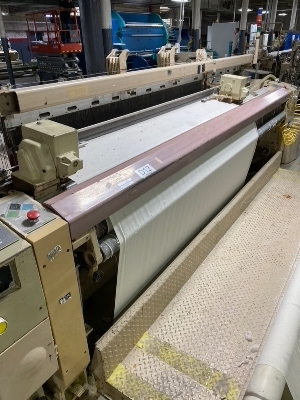
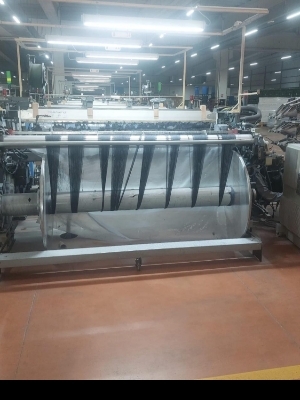
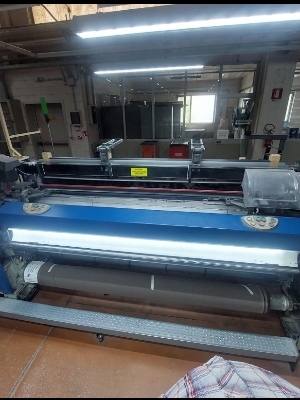
Tsudakoma ZAX Wide-Width Air-Jet Sheeting Looms Make: Tsudakoma Model: ZAX Type: Air-Jet Weaving Loom (Sheeting) Quantity & Size Total Quantity: 19 Nos. Working Width: 280 cm Manufacturing Details Year of Manufacture: 1994 & 1995 Shedding & Motion Shedding System: Staubli 1600 Cam Motion Number of Cams: 6 Harness Frames: 4 Nos. Machine Configuration Single-width warp beam supplied Warp beam head flange diameter: 1000 mm Main Insertion Nozzles: 2 Nos. Filling Feeders: 2 Nos. with creel stand Warp Stop Motion: 5 drop-wire contact bars Selvedge: Right-hand & Left-hand side tucking units Electrical Details Power Supply: 575 V / 60 Hz / 3 Phase Additional Equipment (Optional) Alexco Batching Unit (Off-Loom Cloth Take-Up) Machine Condition All looms are complete Machines were running in production at the time of stoppage
Versatile Shedding SystemsChoose from cam, dobby, or jacquard shedding motions with the ZAX Air-Jet Sheeting Loom, enabling customization for a variety of intricate or standard weaving patterns. This flexibility makes the loom suitable for diverse fabric designs, whether simple sheeting or complex home textiles.
Advanced Automation and ControlWith automatic electronic let-off and take-up motions, as well as a touch screen electronic interface, the loom ensures streamlined operation and precise control. The centralized automatic lubrication system reduces maintenance and maximizes uptime for high productivity in demanding environments.
Optimized Performance and Energy EfficiencyOperating at speeds up to 1,200 rpm, the Tsudakoma ZAX delivers high-volume output with optimized air consumption and reduced energy costs. Noise-reducing design further enhances the working environment, making it an excellent choice for modern textile manufacturing units in India.
FAQ's of Tsudakoma ZAX Air-Jet Sheeting Looms:
Q: How does the Tsudakoma ZAX loom optimize air consumption and operational efficiency?
A: The ZAX loom is engineered with an air jet weft insertion system and advanced automation that optimize air consumption, reduce waste, and enhance energy efficiency. This ensures consistent performance while minimizing running costs, supporting sustainable operations even during high-output weaving.
Q: What materials can be processed with this air-jet sheeting loom?
A: The loom is compatible with a wide range of materials, including 100% cotton, polyester, blended yarns, and various sheeting materials. This versatility makes it suitable for diverse applications such as high-quality bed sheeting, home textiles, and industrial fabrics.
Q: When is it advisable to use the jacquard, dobby, or cam shedding motions?
A: Cam shedding is recommended for simple, repetitive patterns, dobby for medium complexity designs, and jacquard for intricate, elaborate motifs. The ZAX allows seamless switching among these systems, supporting variable production demands efficiently.
Q: Where can the Tsudakoma ZAX loom be installed and serviced in India?
A: The ZAX loom is available through certified suppliers, service providers, and traders across India. Expert installation, maintenance, and after-sales support ensure that the machine operates at optimal capacity in textile production units nationwide.
Q: What is the process for selecting the weft colors and controlling weaving operations?
A: An advanced electronic interface with a touch screen panel makes it easy to choose up to 8 weft colors and manage all loom functions. The user-friendly controls streamline set-up and adjustments, ensuring quick color changes and efficient workflow.
Q: How does the lubrication system benefit long-term loom usage?
A: The centralized automatic lubrication system delivers precise, consistent lubrication to key components, reducing wear, minimizing downtime, and extending the loom's lifespan even under high-speed operation.
Q: What are the main benefits of using the Tsudakoma ZAX for large-scale textile manufacturing?
A: Key advantages include high production speed, energy efficiency, superior fabric quality, low noise levels, minimal maintenance, multi-color weaving, and adaptability to various materials. These features collectively enhance productivity and product diversity for textile businesses.





 Get Latest Price

 Send Inquiry
 Send Inquiry
 Send SMS
 Call Me Free